
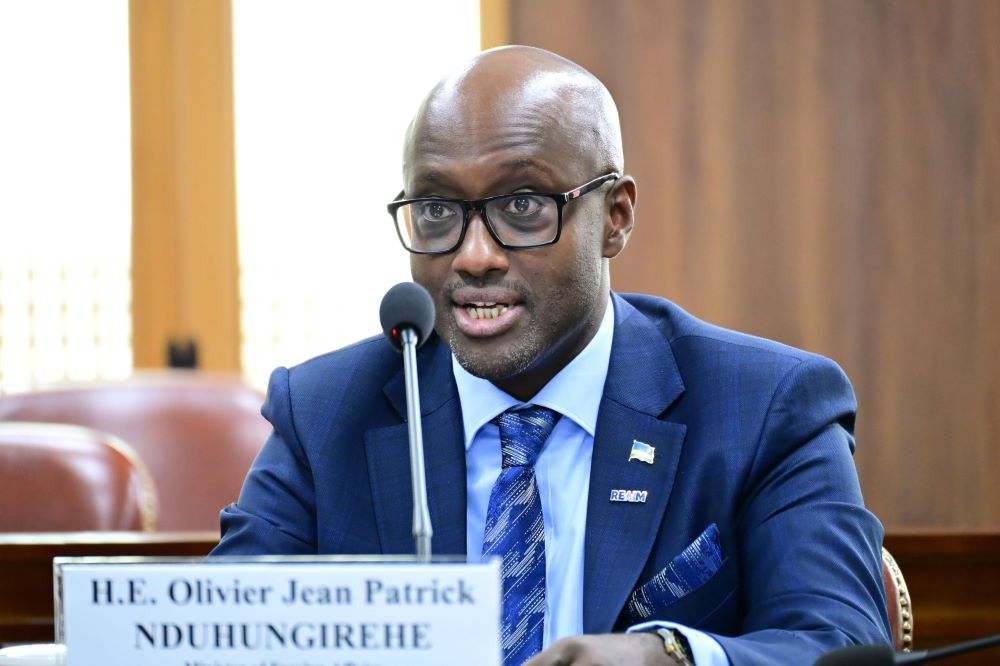
The Minister of Foreign Affairs and International Cooperation of Rwanda, Amb. Olivier Nduhungirehe, has emphasized that the implementation of the peace agreement signed in Washington on December 4, 2025, must go beyond statements and be backed by concrete actions aimed at restoring lasting security in the region.
He made these remarks following recent announcements by the Armed Forces of the Democratic Republic of Congo (FARDC) indicating the start of a process to disarm the FDLR, an armed group associated with the ideology of the 1994 Genocide against the Tutsi.
On March 29, 2026, the Deputy Chief of Staff of the DRC Army, Jacques Ychaligonza Nduru, announced in Kisangani that he had been deployed to Eastern Congo to organize operations targeting the disarmament of FDLR fighters. He stated that the group must lay down its weapons, either voluntarily or by force.
While the statement reflects a military position, Rwanda has expressed concern that such actions were publicly announced instead of being conducted discreetly. According to Rwandan authorities, this approach could allow targeted groups to adapt or evade operations.
In an interview with international media, Minister Nduhungirehe reiterated that the successful implementation of the Washington Agreement requires genuine political will and measurable actions, not rhetoric.
“The peace and economic cooperation agreements signed in Washington will not be fulfilled through words alone. They require concrete measures, including the complete eradication of the FDLR,” he said.
The Government of the DRC has consistently denied any collaboration between its forces and the FDLR, and has accused Rwanda of using the group as a justification for its security concerns.
However, Rwanda maintains that there is evidence suggesting FDLR elements have infiltrated FARDC structures and continue to participate in armed activities in Eastern Congo, as well as in spreading genocidal ideology.
The Washington agreement, signed between Rwanda and the DRC with support from the United States, outlines a detailed military framework known as CONOPS (Concept of Operations), aimed at restoring stability in the region.
Under the terms of the agreement, the lifting of Rwanda’s defensive security measures is contingent upon the complete neutralization of the FDLR within Congolese territory.