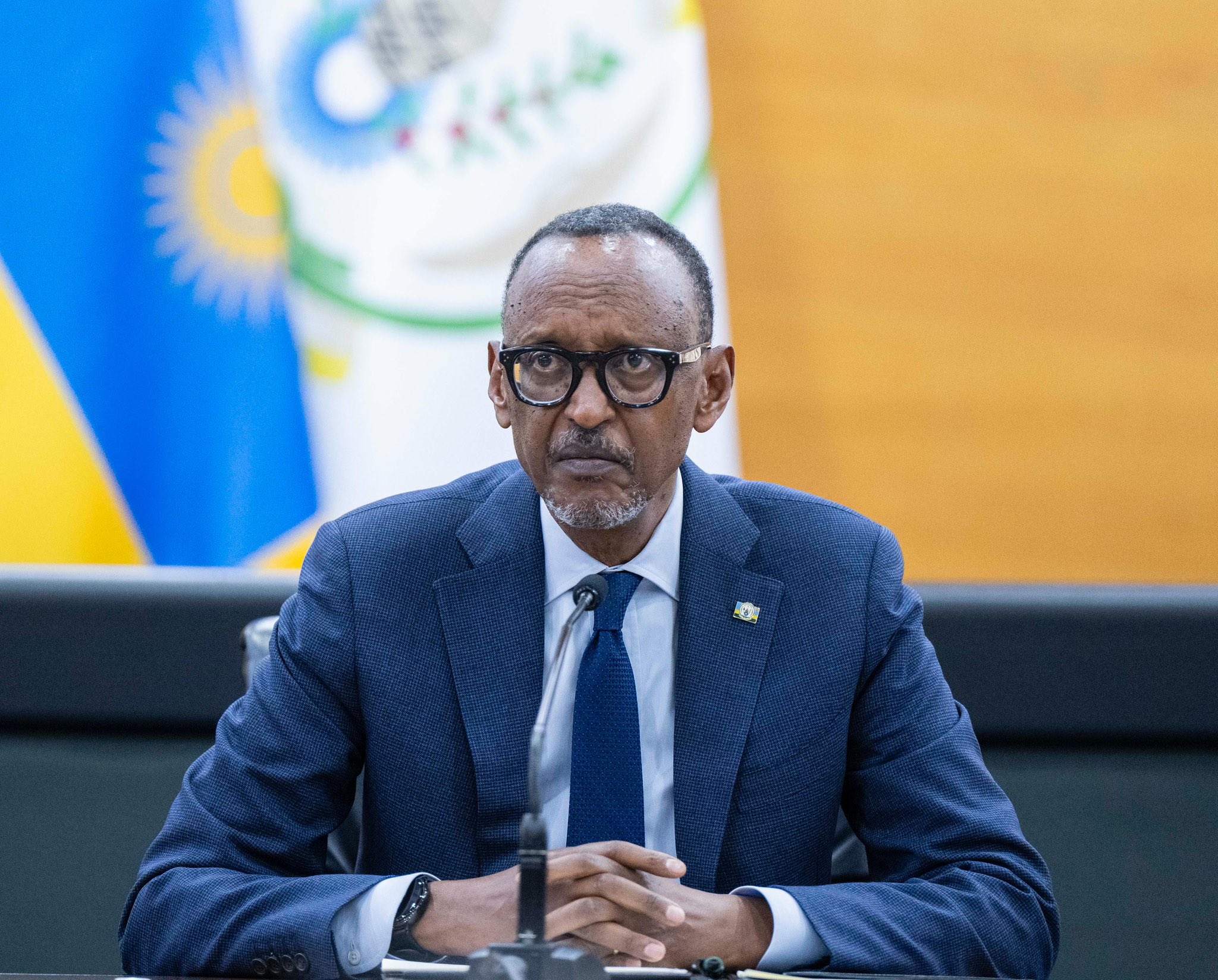
President Paul Kagame has stated that the M23 rebel group did not originate in Rwanda but is a Congolese movement operating under the coalition known as AFC/M23 and cooperating with former Congolese President Joseph Kabila.
Kagame made the remarks during an interview with journalist François Soudan published by Jeune Afrique, where he addressed several issues including sanctions imposed on Rwanda, the implementation of the Washington agreements, and the country’s defensive security measures.
Responding to questions about the relationship between Rwanda and the M23 group, Kagame said the movement does not pose a problem for Rwanda but instead reflects an internal political issue within the Democratic Republic of the Congo that should be resolved politically inside the country.
“M23 is not a group originating from Rwanda. It is a Congolese movement called AFC/M23, which works with former President Joseph Kabila. The problem it represents is an internal political issue in Congo that should be addressed politically within Congo,” Kagame said.
Kagame also commented on sanctions recently imposed by the United States on four officers of the Rwanda Defence Force, including the army chief Gen. Mubarak Muganga.
He argued that agreements meant to address the conflict appear to place responsibility mainly on Rwanda while the Congolese side does not fully implement its commitments.
“You cannot expect one side Rwanda to implement the provisions of the Washington agreements signed on December 4, 2025, while the other side, the DRC, either partially implements its obligations or does nothing,” he said.
Kagame added that the United States, which facilitated the talks, should ensure that both Rwanda and the Democratic Republic of Congo respect the agreement rather than appearing to pressure only one side.
The Rwandan leader also defended his country’s defensive measures, explaining that they are meant to protect Rwanda’s borders and territory from potential threats.
“If protecting our borders requires keeping an enemy 5, 10, or even 20 kilometers away, that is a defensive measure,” he said.
Kagame further criticized the alleged cooperation between the Congolese government and the armed group FDLR, which he said continues to strengthen.
“The problem is not their numbers. Whether they are hundreds or thousands, the real issue is their ideology and the fact that they are supported by the Congolese government,” he said.
According to Kagame, the long-term solution lies in fully implementing existing agreements, including those brokered by the United States in Washington.
On June 27, 2025, Rwanda and the Democratic Republic of Congo signed a peace agreement with mediation from the United States. The deal focused on dismantling the FDLR and removing Rwanda’s defensive measures.
The agreement was reaffirmed on December 4, 2025, adding regional economic cooperation in trade, mining, and infrastructure development.
However, Rwanda has repeatedly argued that the Congolese government has not taken meaningful steps to dismantle the FDLR, a group composed in part of individuals linked to the perpetrators of the 1994 genocide against the Tutsi in Rwanda.