As Rwanda continues its journey toward Vision 2050, aiming to become a high-income country, the government has announced plans to invest $6 billion (approximately RWF 8.7 trillion) in nuclear energy. The initiative is designed to expand the country’s electricity capacity and support sustainable economic growth.
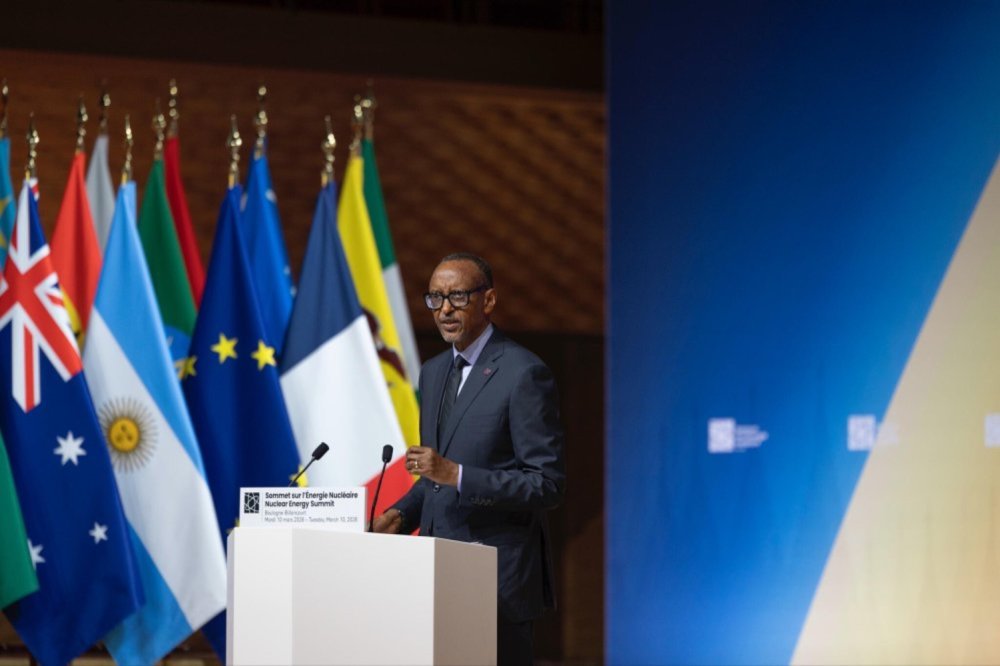
President Paul Kagame made the announcement while attending the International Conference on Nuclear Energy Development in Paris, France, on March 10, 2026. He called on the international community to support developing countries in building nuclear infrastructure capable of meeting future energy needs.
Nuclear Energy at the Core of Rwanda’s Development
President Kagame emphasized that nuclear power is central to Rwanda’s sustainable growth ambitions. The country anticipates needing at least 3,000 MW of electricity to support its economic transformation by 2050.
“Rwanda has set its sights on joining the ranks of high-income countries by 2050. Adequate electricity is essential, which is why we are incorporating nuclear energy into our national development plans,” he said.
The nuclear program will complement existing renewable energy projects, including hydro, solar, and methane gas, and is expected to begin supplying power by 2030.
Small Modular Reactors (SMRs)
Rwanda is focusing on Small Modular Reactors (SMRs), a modern nuclear technology that is safe, scalable, and suitable for local needs. President Kagame highlighted that SMRs will enhance the electricity grid while supporting industrial development, mining, and digital infrastructure.
The nuclear program aims to provide at least 5,000 MW by 2050, ensuring sufficient energy to sustain long-term economic growth.
Capacity Building and International Cooperation
Rwanda has been preparing technically and operationally for nuclear energy deployment. The Rwanda Atomic Energy Board (RAEB) is collaborating closely with the International Atomic Energy Agency (IAEA) to strengthen regulatory oversight and safety measures.
The government plans to train over 230 nuclear experts by 2028 to manage and lead the sector. Recent IAEA audits have confirmed that Rwanda has made significant progress toward meeting the requirements for constructing the first fully operational nuclear facility, expected by 2030.
Funding and Partnerships
President Kagame noted that nuclear projects require specialized financing, often unavailable through conventional development banks. He called on international financial institutions to expand support for nuclear energy projects and praised the World Bank for initiating a study on removing regulatory barriers to funding.
Rwanda has already partnered with Dual Fluid Energy Inc. (Germany and Canada) to test nuclear technology locally, and is collaborating with companies from Russia and the United States to explore SMR construction.
The SMRs are expected to occupy 10–15 hectares, employ around 230 specialists, and deliver clean electricity to supplement the national grid.
Looking Ahead
Rwanda is preparing to host the 2026 African Nuclear Innovation Conference, bringing together governments, investors, and industry leaders to discuss the future of nuclear energy on the continent.
President Kagame reaffirmed that Rwanda’s nuclear program will be strictly for civilian use, primarily focusing on electricity generation and medical applications